

Edited collections and scholarly monographs present a hierarchical metadata challenge that flat journal serialization schemas cannot resolve. Standard journal publishing relies on ANSI/NISO Z39.96 (JATS), which models individual standalone articles via the <article> root. Conversely, consumer digital publishing relies on IDPF/W3C EPUB 3.3, where package metadata (content.opf) is global to the publication; structural division semantics (epub:type="chapter") lack expressive, machine-readable mechanisms for independent abstract indexing, contributor attribution, licensing, and persistent identifiers.
When publishers submit multi-authored monographs to open-access aggregators such as OAPEN, the Directory of Open Access Books (DOAB), JSTOR, and Crossref, indexing systems require granular, chapter-level citation indexing. A failure to expose persistent identifiers at the chapter boundary causes citation truncation: downstream crawlers attribute all citations to the volume editors rather than chapter authors, and chapter-level digital object identifiers (DOIs) fail to resolve.
The definitive technical specification for this hierarchy is ANSI/NISO Z39.102-2017: Book Interchange Tag Suite (BITS 2.0/2.1). BITS extends JATS to model whole books, multi-part monographs, and reference works. In an edited volume, the book-level wrapper <book> maintains volume metadata within <book-meta>, while each individual chapter must be encapsulated as a discrete <book-part> within <book-body>, governed by its own independent <book-part-meta> container.
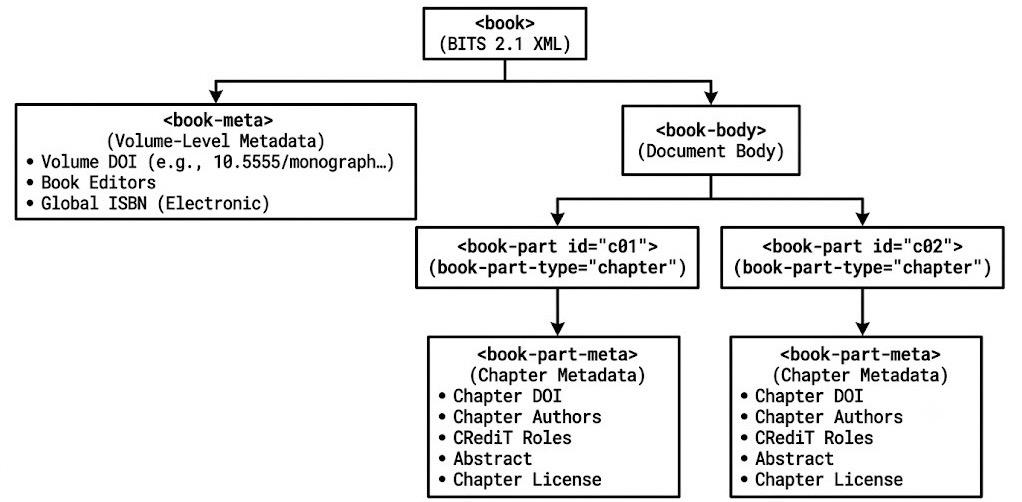
Pipeline Architecture
Aggregator ingestion pipelines for OAPEN and Crossref require structural isolation between global monograph data and chapter payloads. Processing raw manuscripts into production-grade BITS XML follows a four-stage pipeline:
- Extraction & Canonicalization: Source Word/DOCX or Markdown manuscripts are decomposed into modular chapter components. Pandoc or internal parser systems convert tabular front matter into structured intermediate XML.
- Structural Composition via XSLT 3.0: An orchestration stylesheet wraps chapter bodies within
<book-part book-part-type="chapter">, mints deterministic XML IDs, and maps chapter-specific metadata into<book-part-meta>. - DTD Schema Conformance: The assembled monograph document is validated against the formal NISO BITS 2.1 DTD (
BITS-book2-1.dtd) usingxmllintto ensure grammar and entity validity. - Semantic Business Rule Enforcement: An ISO Schematron (ISO/IEC 19757-3) assertion suite validates publisher constraints that DTDs cannot express: confirming that every
<book-part>of typechaptercontains a valid DOI syntax, an abstract, explicit contributor affiliations, and an active Creative Commons URI.
Executable Implementation
The following structural template demonstrates a production-compliant BITS 2.1 document fragment featuring an edited monograph chapter with full metadata encapsulation.
<?xml version="1.0" encoding="UTF-8"?>
<!DOCTYPE book PUBLIC "-//NLM//DTD BITS Book Interchange Tag Suite v2.1 20220202//EN"
                      "BITS-book2-1.dtd">
<book xmlns:xlink="http://www.w3.org/1999/xlink"
      xmlns:mml="http://www.w3.org/1998/Math/MathML"
      xml:lang="en"
      book-indexing-type="monographic">
  <book-meta>
    <book-id pub-id-type="doi">10.5555/monograph.2026.01</book-id>
    <book-id pub-id-type="isbn" publication-format="electronic">978-1-99999-000-1</book-id>
    <book-title-group>
      <book-title>Automated Publishing Pipelines in Practice</book-title>
    </book-title-group>
    <contrib-group content-type="volume-editors">
      <contrib contrib-type="editor">
        <name>
          <surname>Vance</surname>
          <given-names>Elena</given-names>
        </name>
      </contrib>
    </contrib-group>
    <pub-date date-type="pub" publication-format="electronic">
      <year>2026</year>
      <month>10</month>
      <day>01</day>
    </pub-date>
    <publisher>
      <publisher-name>Zeba Academy Press</publisher-name>
    </publisher>
  </book-meta>

  <book-body>
    <book-part id="bp-c01" book-part-type="chapter" xml:lang="en">
      <book-part-meta>
        <book-part-id pub-id-type="doi">10.5555/monograph.2026.01.c01</book-part-id>
        <title-group>
          <title>Deterministic Layout Generation via Paged Media</title>
        </title-group>
        <contrib-group>
          <contrib contrib-type="author">
            <contrib-id contrib-id-type="orcid">https://orcid.org/0000-0002-1825-0097</contrib-id>
            <name>
              <surname>Sterling</surname>
              <given-names>Marcus</given-names>
            </name>
            <role vocab="credit"
                  vocab-identifier="https://credit.niso.org/"
                  vocab-term="Writing – original draft"
                  vocab-term-identifier="https://credit.niso.org/contributor-roles/writing-original-draft/">Writing – original draft</role>
            <xref ref-type="aff" rid="aff-01">1</xref>
          </contrib>
        </contrib-group>
        <aff id="aff-01">
          <label>1</label>
          <institution-wrap>
            <institution-id institution-id-type="ror">https://ror.org/03yrm5c26</institution-id>
            <institution>Institute for Digital Typography</institution>
          </institution-wrap>
        </aff>
        <pub-date date-type="pub" publication-format="electronic">
          <year>2026</year>
        </pub-date>
        <abstract>
          <p>This chapter examines reproducible print generation utilizing declarative CSS Paged Media pipelines.</p>
        </abstract>
        <kwd-group kwd-group-type="author">
          <kwd>Paged Media</kwd>
          <kwd>Print Automation</kwd>
        </kwd-group>
        <permissions>
          <copyright-statement>© 2026 Marcus Sterling</copyright-statement>
          <license license-type="open-access"
                   xlink:href="https://creativecommons.org/licenses/by/4.0/">
            <license-p>Distributed under Creative Commons Attribution 4.0 International.</license-p>
          </license>
        </permissions>
      </book-part-meta>
      <body>
        <p>Production typesetting workflows must guarantee idempotent rendering across environments.</p>
      </body>
      <back>
        <ref-list id="ref-list-c01">
          <ref id="c01-bib01">
            <element-citation publication-type="journal">
              <person-group person-group-type="author">
                <name><surname>Tschichold</surname><given-names>Jan</given-names></name>
              </person-group>
              <article-title>The Principles of the New Typography</article-title>
              <year>1928</year>
            </element-citation>
          </ref>
        </ref-list>
      </back>
    </book-part>
  </book-body>
</book>
To prevent ingestion halts at OAPEN and Crossref, structural rules are enforced through the following ISO Schematron file (bits-chapter-rules.sch):
<?xml version="1.0" encoding="UTF-8"?>
<schema xmlns="http://purl.oclc.org/dsdl/schematron"
queryBinding="xslt2">
<title>OAPEN/BITS Monograph Chapter Ingestion Rules</title>
<ns prefix="xlink" uri="http://www.w3.org/1999/xlink"/>
<pattern id="chapter-metadata-integrity">
<rule context="book-part[@book-part-type='chapter']">
<assert test="book-part-meta"
role="error">Every chapter must contain a <book-part-meta> container.</assert>
<assert test="book-part-meta/book-part-id[@pub-id-type='doi']"
role="error">Chapter (<value-of select="@id"/>) is missing a chapter-level DOI.</assert>
<assert test="matches(book-part-meta/book-part-id[@pub-id-type='doi'], '^10\.\d{4,9}/[-._;()/:A-Za-z0-9]+$')"
role="error">Chapter DOI format is invalid.</assert>
<assert test="book-part-meta/contrib-group/contrib[@contrib-type='author']"
role="error">Chapter must designate at least one author in <contrib-group>.</assert>
<assert test="book-part-meta/abstract"
role="error">Chapter must provide an <abstract> for OAPEN indexing.</assert>
<assert test="book-part-meta/permissions/license/@xlink:href"
role="error">Chapter must define an open-access license URI.</assert>
</rule>
</pattern>
<pattern id="cross-reference-scoping">
<rule context="book-part//xref">
<let name="target-id" value="@rid"/>
<assert test="ancestor::book-part//*[@id = $target-id]"
role="error">Reference pointer '<value-of select="$target-id"/>' resolves outside the chapter scope. Cross-chapter cross-references must use explicit <related-object> tags.</assert>
</rule>
</pattern>
</schema>Automated Validation
The verification routine executes in standard POSIX automation environments using xmllint for DTD validation and an ISO Schematron compiler (or Python CLI) for assertion checks.
#!/usr/bin/env bash
set -euo pipefail

BITS_XML="monograph-production.xml"
SCHEMATRON="bits-chapter-rules.sch"

echo "[PREFLIGHT 1/2] Executing BITS 2.1 DTD Validation..."
xmllint --noout --dtdvalid "http://jats.nlm.nih.gov/extensions/bits/2.1/dtd/BITS-book2-1.dtd" "${BITS_XML}"

echo "[PREFLIGHT 2/2] Compiling and Executing Schematron Assertions..."
python3 - <<EOF
import sys
from lxml import etree

xml_doc = etree.parse("${BITS_XML}")
sch_doc = etree.parse("${SCHEMATRON}")

# Translate Schematron to XSLT using ISO implementation
schematron_transform = etree.Schematron(sch_doc)
is_valid = schematron_transform.validate(xml_doc)

if not is_valid:
    print("FATAL: Schematron assertions failed!", file=sys.stderr)
    for error in schematron_transform.error_log:
        print(f"  Line {error.line}: {error.message}", file=sys.stderr)
    sys.exit(1)

print("PASSED: All chapter-level metadata assertions passed.")
sys.exit(0)
EOF
CLI assertion output on success:
$ ./validate-monograph.sh
[PREFLIGHT 1/2] Executing BITS 2.1 DTD Validation...
[PREFLIGHT 2/2] Compiling and Executing Schematron Assertions...
PASSED: All chapter-level metadata assertions passed.
Production Gotchas
- Global ID Collisions in Consolidated
<book>Trees:When independent chapter XML files are concatenated into a monolithic<book-body>, shared reference IDs (e.g.,id="bib01"orid="fn01") collide, triggering DTD invalidity (ID bib01 already defined). To prevent XML parser errors, enforce deterministic prefixing during transformation: every internal anchor within chapter $N$ must be dynamically rewritten asid="c01-bib01"using an XSLT identity transform before aggregation. - Hierarchical License Shadowing:Publishers frequently define an open-access license at
<book-meta><permissions>, but fail to reproduce<permissions>within<book-part-meta>. Aggregator ingestion bots evaluating chapter feeds in isolation (e.g., OAPEN chapter deposits or Crossref chapter DOI deposits) treat the absence of<book-part-meta>/<permissions>as “All Rights Reserved”, omitting the chapter from open repositories. Always declare permissions explicitly at both the monograph and chapter levels. - Contributor Scoping and ORCID Propagation:Omitting
<contrib-group>at the<book-part-meta>level forces automated catalogers to inherit the<book-meta>editors as chapter authors. This skews citation metadata across Crossref, Google Scholar, and indexers. Every chapter must maintain its own<contrib-group>, complete with institutional affiliations (<aff>) and canonical ORCID URIs ([https://orcid.org/](https://orcid.org/)...).