

Commercial sheetfed offset and print-on-demand (POD) finishing lines rely on mechanical guillotines operating at speeds exceeding 40 cuts per minute. Due to clamp compression, mechanical paper movement, and blade deflection (“knife chatter”), hydraulic cutting tolerances fluctuate by up to ±1.5 mm. To eliminate raw paper slivers on finished edges, commercial prepress workflows enforce a mandatory 3 mm (8.504 pt) exterior bleed zone coupled with high-precision registration and crop marks offset from the trim path.
In automated digital document pipelines, generating print-ready PDFs directly from HTML/CSS frequently triggers prepress rejection at the Raster Image Processor (RIP). Headless rendering engines often fail to construct the discrete coordinate boxes mandated by ISO 32000-1 and the ISO 15930 (PDF/X) exchange standards. Specifically, a print-compliant PDF requires unambiguous distinction among five nesting bounding boxes:
- MediaBox: The overall dimensions of the physical carrier sheet or canvas, encompassing trim, bleed, crop marks, and slug metadata.
- BleedBox: The boundary to which the page contents must be clipped when bleed is present (Trim dimensions + 3 mm on all active edges).
- TrimBox: The exact finished dimensions of the asset after mechanical post-print guillotining.
- CropBox: The visual clipping boundary applied by default in desktop PDF viewing applications.
- ArtBox: The boundary defining the meaningful page content or ad boundaries.
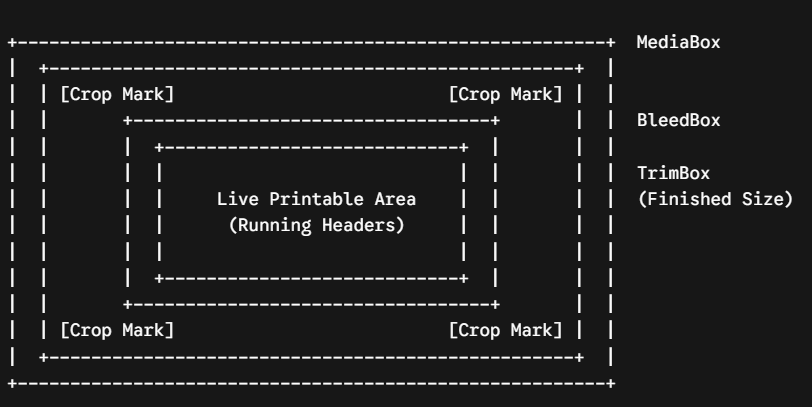
When headless pipelines compile standard CSS declarations, naive engines default to mapping MediaBox == TrimBox. This clips edge-running imagery at the trim line. Conversely, engines that synthesize bleed without injecting an explicit /TrimBox dictionary key cause commercial imposition software (such as Kodak Prinergy or Heidelberg Prinect) to miscalculate page origins, resulting in misaligned double-sided work and spine creep. Enforcing the W3C CSS Paged Media Module Level 3 specification within standards-compliant layout engines resolves this bottleneck at the document compilation tier.
Pipeline Architecture
The automated compilation pipeline translates semantic markup into an ISO 15930-compliant page coordinate structure through deterministic CSS Paged Media rendering. The transformation model operates across three discrete abstraction layers:
[HTML Source + Semantic CSS]
            │
            ▼
[CSS Paged Media Layout Engine (WeasyPrint / Paged.js)]
   ├── 1. Compute Trim Size via @page { size: ... }
   ├── 2. Apply Exterior Offset via @page { bleed: 3mm }
   ├── 3. Synthesize Marks Geometry via @page { marks: crop cross }
   └── 4. Map Running Headers via Margin Boxes (@top-left, @bottom-right)
            │
            ▼
[PDF Serialization Engine]
   ├── Write /MediaBox  [0 0 (TrimW + Slugs) (TrimH + Slugs)]
   ├── Write /BleedBox  [OffsetX OffsetY (TrimW + Bleed) (TrimH + Bleed)]
   └── Write /TrimBox   [TrimX TrimY (TrimX + TrimW) (TrimY + TrimH)]
            │
            ▼
[Automated Preflight Verification (Poppler pdfinfo)]
At the core of the engine, dimensions specified in metric or imperial units are converted to native PostScript user units ($1\text{ in} = 72\text{ pt} = 25.4\text{ mm}$, yielding $1\text{ mm} \approx 2.834646\text{ pt}$). When bleed: 3mm; and marks: crop cross; are declared inside the @page context, the layout engine expands the underlying MediaBox canvas beyond the target trim size.
It calculates an outer gutter sufficient to draw 0.25 pt stroke crop marks and registration targets, ensures the BleedBox extends exactly 8.504 pt beyond the TrimBox, and maintains the internal margin boxes (@top-left, @bottom-right) pinned relative to the TrimBox rather than the variable sheet edges.
Executable Implementation
The implementation uses standard W3C CSS Paged Media Module Level 3 properties rendered via the WeasyPrint engine.
Save the following stylesheet as print-specs.css:
/* ==========================================================================
   PRODUCTION PRINT CSS: TRIM, 3MM BLEED, MARKS, AND MARGIN BOXES
   Target: ISO Standard A5 Trim (148mm x 210mm) + 3mm Bleed
   ========================================================================== */

@page {
    /* 1. Define Trim Dimensions */
    size: 148mm 210mm;

    /* 2. Commercial Print Extension */
    bleed: 3mm;
    marks: crop cross;

    /* 3. Margins relative to the Trim Line (Finished Page Edge) */
    margin-top: 20mm;
    margin-bottom: 25mm;
    margin-inside: 20mm;
    margin-outside: 15mm;

    /* 4. Margin Box Running Headers & Footers */
    @top-left {
        content: string(book-title);
        font-family: "Liberation Sans", sans-serif;
        font-size: 8pt;
        font-weight: 600;
        text-transform: uppercase;
        letter-spacing: 0.05em;
        vertical-align: bottom;
        padding-bottom: 3mm;
        border-bottom: 0.5pt solid #1a1a1a;
    }

    @top-right {
        content: string(chapter-title);
        font-family: "Liberation Sans", sans-serif;
        font-size: 8pt;
        font-style: italic;
        vertical-align: bottom;
        padding-bottom: 3mm;
        border-bottom: 0.5pt solid #1a1a1a;
    }

    @bottom-right {
        content: counter(page);
        font-family: "Liberation Mono", monospace;
        font-size: 9pt;
        font-weight: bold;
        vertical-align: top;
        padding-top: 3mm;
    }
}

/* Alternate Running Page Coordinates on Facing Spreads */
@page :left {
    @top-left {
        content: counter(page);
        font-family: "Liberation Mono", monospace;
        font-size: 9pt;
        font-weight: bold;
        border-bottom: 0.5pt solid #1a1a1a;
    }
    @top-right {
        content: string(book-title);
        font-style: normal;
    }
    @bottom-right {
        content: none;
    }
}

/* Suppress Running Headers on First Page / Section Breaks */
@page :first {
    margin-top: 35mm;
    @top-left { content: none; border: none; }
    @top-right { content: none; border: none; }
}

/* ==========================================================================
   DOCUMENT TYPOGRAPHY & LAYOUT UTILITIES
   ========================================================================== */

:root {
    font-size: 10pt;
    line-height: 1.45;
}

body {
    font-family: "Liberation Serif", serif;
    color: #000000;
    margin: 0;
    padding: 0;
}

h1.chapter {
    string-set: chapter-title content();
    break-before: page;
    font-size: 18pt;
    margin-bottom: 12mm;
}

span.title-tracker {
    string-set: book-title content();
}

/* Full-bleed element container */
.full-bleed-figure {
    break-inside: avoid;
    /* Pull content outward past the page margins through the 3mm bleed */
    margin-top: -20mm;
    margin-bottom: 0;
    margin-left: -20mm;
    margin-right: -15mm;
    padding: 0;
    width: calc(100% + 35mm);
}

.full-bleed-figure img {
    display: block;
    width: 100%;
    height: auto;
}
Save the markup harness as document.html:
<!DOCTYPE html>
<html lang="en">
<head>
    <meta charset="UTF-8">
    <title>Production Print Harness</title>
    <link rel="stylesheet" href="print-specs.css">
</head>
<body>
    <span class="title-tracker" style="display:none;">Architectural Preflight Standards</span>

    <section>
        <h1 class="chapter">Chapter 1: Coordinate Geometries</h1>
        <p>Prepress imposition demands exact mathematical adherence to PDF box boundaries. This page verifies automated TrimBox, BleedBox, and MediaBox declarations compiled directly from CSS Paged Media Module Level 3 rules.</p>

        <div class="full-bleed-figure">
            <!-- Simulated background plate that must extend 3mm beyond trim -->
            <div style="background-color: #0d233a; height: 45mm; width: 100%;"></div>
        </div>

        <p>The colored band above extends past the page perimeter into the mechanical bleed allowance, preventing white edge artifacts during trimming.</p>
    </section>
</body>
</html>
Execute compilation using the following production build script (build-print.sh):
#!/usr/bin/env bash
set -euo pipefail

HTML_SRC="document.html"
CSS_SRC="print-specs.css"
PDF_OUT="build/artifact_print.pdf"

mkdir -p build

echo "==> Compiling print-ready PDF via WeasyPrint..."
weasyprint \
    --stylesheet "${CSS_SRC}" \
    --optimize-size all \
    "${HTML_SRC}" \
    "${PDF_OUT}"

echo "==> Compilation complete: ${PDF_OUT}"
Automated Preflight & Box Validation
Post-compilation assertions verify that the layout engine successfully injected explicit /MediaBox, /BleedBox, and /TrimBox dictionaries. Standard compliance can be determined deterministically using pdfinfo from Poppler utilities.
Run the following assertion script (verify-boxes.sh) within CI/CD pipelines to validate geometry down to PostScript point fractions:
#!/usr/bin/env bash
set -euo pipefail

PDF_TARGET="build/artifact_print.pdf"

if [ ! -f "${PDF_TARGET}" ]; then
    echo "CRITICAL: Target PDF does not exist." >&2
    exit 1
fi

echo "==> Inspecting PDF bounding boxes for ${PDF_TARGET}..."
BOX_OUTPUT=$(pdfinfo -box "${PDF_TARGET}")

echo "${BOX_OUTPUT}" | grep -E "(MediaBox|CropBox|BleedBox|TrimBox)"

# Extraction variables (resolving x, y, width, height)
# Target A5 Trim: 148mm x 210mm -> 419.53 pt x 595.28 pt (+/- 1pt)
TRIM_DIMS=$(echo "${BOX_OUTPUT}" | grep "TrimBox:" | awk '{printf "%.2f x %.2f", $4-$2, $5-$3}')
BLEED_DIMS=$(echo "${BOX_OUTPUT}" | grep "BleedBox:" | awk '{printf "%.2f x %.2f", $4-$2, $5-$3}')
MEDIA_DIMS=$(echo "${BOX_OUTPUT}" | grep "MediaBox:" | awk '{printf "%.2f x %.2f", $4-$2, $5-$3}')

echo "Calculated TrimBox:  ${TRIM_DIMS} pt"
echo "Calculated BleedBox: ${BLEED_DIMS} pt"
echo "Calculated MediaBox: ${MEDIA_DIMS} pt"

# Assertion: TrimBox width must equal 419.53 pt (+/- 1 pt tolerance)
# 148 mm * (72 / 25.4) = 419.528 pt
python3 - <<EOF
import sys

def validate(trim_w, trim_h, bleed_w, bleed_h):
    # Base A5 points
    expected_trim_w = 148.0 * 72.0 / 25.4
    expected_trim_h = 210.0 * 72.0 / 25.4
    expected_bleed_delta = 6.0 * 72.0 / 25.4 # 3mm on both sides = 6mm total

    if abs(trim_w - expected_trim_w) > 1.0 or abs(trim_h - expected_trim_h) > 1.0:
        print(f"FAIL: TrimBox mismatch. Expected {expected_trim_w:.2f}x{expected_trim_h:.2f}, got {trim_w:.2f}x{trim_h:.2f}")
        sys.exit(1)

    actual_bleed_w_delta = bleed_w - trim_w
    actual_bleed_h_delta = bleed_h - trim_h

    if abs(actual_bleed_w_delta - expected_bleed_delta) > 1.0 or abs(actual_bleed_h_delta - expected_bleed_delta) > 1.0:
        print(f"FAIL: BleedBox margin mismatch. Expected 6mm expansion ({expected_bleed_delta:.2f} pt), got W:{actual_bleed_w_delta:.2f} H:{actual_bleed_h_delta:.2f}")
        sys.exit(1)

    print("PASS: TrimBox and BleedBox conform to ISO 148x210mm + 3mm bleed specs.")

# Parse raw output values
t_box = [float(x) for x in "${BOX_OUTPUT}".split("TrimBox:")[1].split()[0:4]]
b_box = [float(x) for x in "${BOX_OUTPUT}".split("BleedBox:")[1].split()[0:4]]

validate(t_box[2]-t_box[0], t_box[3]-t_box[1], b_box[2]-b_box[0], b_box[3]-b_box[1])
EOF
Production Gotchas
When implementing headless print generation pipelines, automated systems encounter three recurrent commercial print failures:
- Root Container Clipping (
overflow: hidden): Applyingoverflow: hiddenor fixed viewport dimensions (height: 100vh) to the<html>or<body>element truncates elements attempting to push into the bleed area. Layout engines enforce a hard scissor mask at the calculatedTrimBoxboundary. Full-bleed background bands or hero artwork must calculate negative margins relative to the base margin box without encountering parent clipping contexts. Ensure body elements maintainoverflow: visible;across print media targets. - Margin Box Collision during Page Creep Compensation: When multi-signature book blocks are folded during saddle-stitching, inner pages displace outward relative to outer pages—a phenomenon known as page creep. If running headers populated inside
@top-leftor@top-rightare placed too close to the trim border (e.g., within 3 mm), post-imposition creep shifting will clip headers during guillotining. Keep all margin box content at least 5 mm interior to the declared trim line to protect critical typographical elements. - Printer Mark Color Knockouts in Spot Color Workflows: By default, some rendering engines render crop marks using device black (
#000000/DeviceRGB 0,0,0) instead of the PostScript Separation ColorAll(Registration Color). On 4-color or 5-color offset presses, marks rendered purely in process black will not register on the Cyan, Magenta, or Yellow printing plates, rendering visual alignment impossible for the press operator. Verify that your engine’s crop mark generation utilizes 100% tint across all process separations, or generate clean, unmarked PDFs and delegate crop-mark generation entirely to your prepress imposition RIP.